District Profile
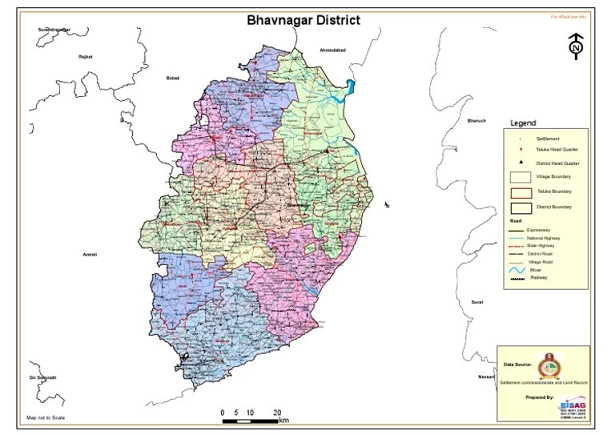
Overview of Bhavnagar district:
Bhavnagar District is situated in South East corner of Saurashtra Peninsula of Gujarat between 21.18° North Latitude and 71.03° to 72.09° East Longitude. It is surrounded by Surendranagar, Botad and Ahmedabad Districts on North, Rajkot and Amreli Districts on the west, Arabian Sea on South and Gulf of Cambay on East. It has a Coast line of about 152 Kms. It has a geographical area of 9971 Sq. Kms.
Climate and Agro-climatic zones:
Exhibiting diverse climatological conditions, the district falls under three different agro-climatic zones of Gujarat:
- Agro-climatic zone V (Bhal & coastal)
- Agro-climatic zone VI (South Saurashtra)
- Agro-climatic zone VII (North Saurashtra)
The maximum temperature recorded of the district is 450C in summer while the minimum temperature is 90C in winter. The average rainfall of the district is 732 mm brought by southwest wind during monsoon.
The district is divided into 10 strata called blocks or Talukas, comprising 656 gram panchayats and 689 villages:
(1) Bhavnagar, (2) Sihor, (3) Umrala, (4) Vallabhipur, (5) Ghogha, (6) Gariadhar, (7) Palitana, (8) Mahuva, (9) Talaja and (10) Jesar
Soil and water:
The geographical formation of Saurashtra is of volcanic origin, hence the soils of Bhavnagar district with the exception of a few strips, are derived from basalt rock known as Deccan trap. The black cotton soils, which are not very deep, are susceptible to erosion in the undulating areas of the district due to rains. The soils along the coastal belt are, however, deeper and plainer but due to their lowness get inundated by the ingress of sea water. As per the statistical report of the district, the total geographical area for land utilization is 6.84 lakh ha., out of which, 4.38 lakh ha is cultivated area.
There is no perennial river flowing through Bhavnagar district. There are 3 to 4 major ephemeral rivers flowing in the district. Canals from these rivers are important sources for lift and surface irrigation. On an average, the area under irrigation is 40 percent in Bhavnagar district.
Agriculture:
Bhavnagar is primarily an agricultural district. The major crops grown in Kharif season are cotton, groundnut, pearl millet and sorghum whereas, in Rabi season wheat, chickpea, onion and vegetables are main crops. During summer season Groundnut, pearl millet, sesame and vegetables are grown. Guava, kagzi lime, mango and coconut are the major fruit crops grown in the district.
The cropping intensity in Ghogha block is 197 percent and ranks second in the district after Talaja block where cropping intensity is 213 percent. In other blocks of Bhavnagar district, cropping intensity ranges from 127 to 173 percent. Average cropping intensity of the district is 162 percent. As per the livestock census, the cattle population is about 3.4 lakh with the same population of buffaloes.